
Modular UPS: how hot-swap capacity actually scales
A traditional UPS is sized once, for the load it was bought for. A modular UPS is sized in stages: the frame goes in once, and power modules are added as the load grows, without swapping the whole system out.
One frame, many power modules
A modular UPS replaces one large, fixed-capacity power section with a frame that accepts multiple smaller, hot-swappable power modules. Each module is a complete online double-conversion power path; the frame is shared logic, distribution and parallel control.
FIBER OCEAN’s FO-MUPS Series is built from 30, 50 and 100 kW power modules, and the same frame family scales from a 10 kVA edge cabinet up to a 1.6 MW (1600 kVA) data-hall system, in no-master-slave parallel across up to eight frames.
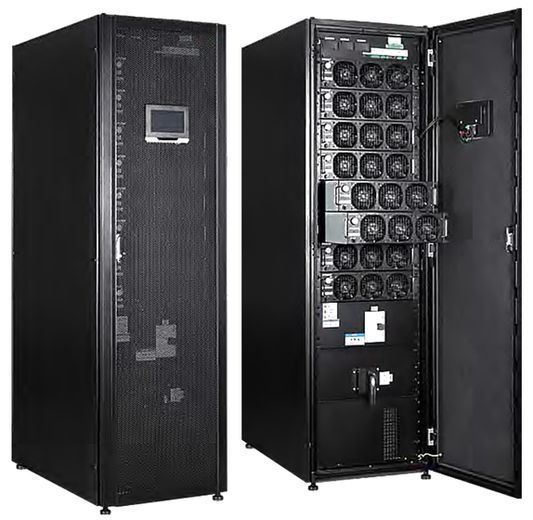
10 kVA to 1.6 MW, one family
The FO-MUPS capacity line-up, drawn directly from the FIBER OCEAN datasheet, shows how module size changes as system capacity grows.
| Model | System capacity | Power module |
|---|---|---|
| FO-MUPS-3310 | 10 kVA | Small-modular |
| FO-MUPS-3380 | 80 kVA | Small-modular |
| FO-MUPS-33120 | 120 kVA | 30 kW modules |
| FO-MUPS-33300 | 300 kVA | 50 kW modules |
| FO-MUPS-33600 | 600 kVA | 50 / 100 kW modules |
| FO-MUPS-33800 | 800 kVA | 100 kW modules |
| FO-MUPS-331000 | 1000 kVA (1 MW) | 100 kW modules |
| FO-MUPS-331600 | 1600 kVA (1.6 MW) | 100 kW modules |
Intermediate system capacities and long-backup versions are available; frame size, module rating and redundancy are configured per project.
N+1 redundancy without a second UPS
The real advantage of modular power is what happens when something goes wrong, and when the load grows.
N+1 as standard
No-master-slave parallel with N+1 module redundancy keeps the load protected through any single module fault, without a second full UPS.
Service without downtime
A failed module is pulled and replaced live; the remaining modules carry the load through the swap, at 0 ms transfer time.
Grow by adding modules
Capacity is added in 30, 50 or 100 kW steps as the load grows, instead of over-buying capacity on day one or replacing the UPS later.
Efficiency at partial load
Up to 97% online efficiency, and up to 99% in ECO mode, because idle modules do not have to run at low, inefficient load points.
The parameters worth checking
Topology & overload
Online double-conversion; overload capacity of 110% for 60 minutes, 125% for 10 minutes, 150% for 1 minute, and 200% to bypass.
Battery compatibility
Sealed lead-acid or LiFePO4, on shared or per-frame banks, so the battery choice does not lock in the UPS choice.
Communication
RS232, RS485, dry contact and MODBUS as standard, SNMP optional, plus a 7-inch colour touch LCD on the frame.
When modular is the right call, and when it is not
Modular UPS earns its cost at sites that expect to grow, or that cannot tolerate the downtime a monolithic UPS needs for service. A fixed, small edge load with no growth plan may be served just as well by a rack-mount UPS.
Related guides
Telecom rectifier systems
The DC-side equivalent: hot-swap rectifier modules, N+1 and how to size them.
Read the guideMicro data center solutions
How a rack UPS fits inside a fully integrated cabinet-scale data center.
Read the guideAll Insights guides
Explainers on rectifier systems, UPS, cooling, batteries and micro data centers.
Browse InsightsFrequently asked questions
What is the capacity range of FIBER OCEAN’s modular UPS?
The FO-MUPS Series scales from 10 kVA to 1.6 MW (1600 kVA) on one frame family, using 30, 50 and 100 kW power modules.
What efficiency does a modular UPS achieve?
Up to 97% online efficiency, rising to up to 99% in ECO mode.
Can a modular UPS be serviced without shutting down the load?
Yes. No-master-slave parallel with N+1 module redundancy lets a technician pull and replace a failed module live, with 0 ms transfer time between mains, battery and bypass.
What batteries work with the FO-MUPS Series?
Sealed lead-acid or LiFePO4 lithium batteries, on shared or per-frame banks.
What overload capacity does the FO-MUPS Series support?
110% for 60 minutes, 125% for 10 minutes, 150% for 1 minute, and 200% to bypass.
Scope your modular UPS
Share your present and planned load, and our engineers will confirm frame size, module count and redundancy.