
Turn sunlight into uptime
A solar array on its own is a promise; integrated with storage, conversion and supervision it becomes infrastructure. FIBER OCEAN engineers PV into the site’s power system, from the charging electronics to the storage block to the ledger that proves the yield.
Harvest, store, back, prove
Four jobs between the panel and the payback. We engineer all four from our own lines, so the array is a source in the system, not an ornament beside it.
Harvest
Arrays feed the plant through solar-compatible charging at 10–50 A, native to the DC range, on telecom sites and rooftops alike.
Store
EnergyGuard BESS from 50 kW cabinets to 1 MWh containers shifts the harvest to the hours that need it, cutting grid dependency.
Back
A zero-transfer battery and a genset that runs only as the last resort keep the site on air through cloud, night and outage.
Prove
Energy by day, month and year with year-on-year ratios: the diesel and grid savings arrive as auditable numbers.
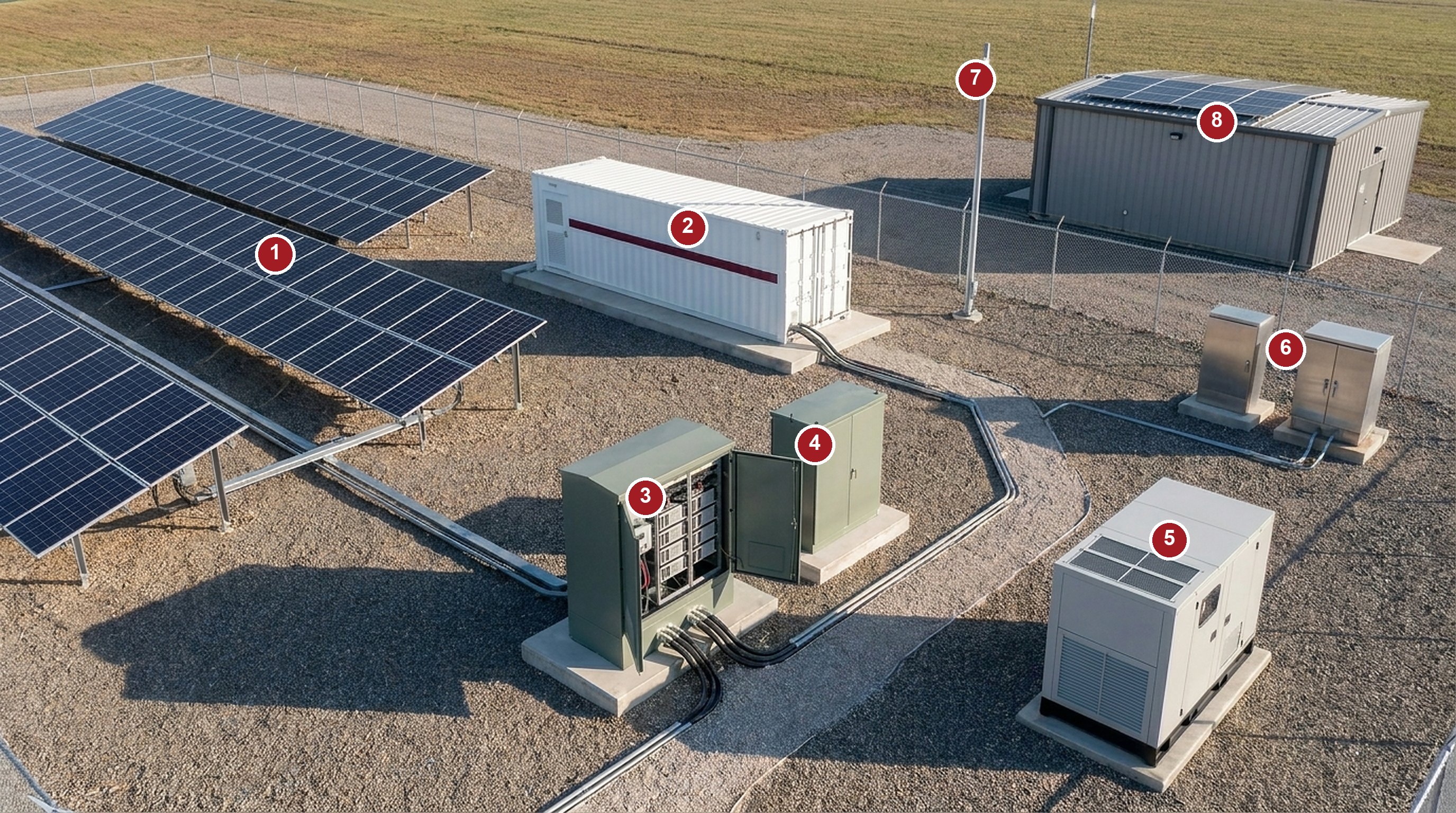
Anatomy of a FIBER OCEAN solar site
Eight layers between the panel and the payback. Every numbered element is a FIBER OCEAN line or an array integrated through one.
| Layer | What we deploy | Product line |
|---|---|---|
| 1. The array input | Ground and rooftop PV integrated through 10–50 A solar-compatible charging that is native to the DC plant | DC Power Systems |
| 2. Storage behind the sun | EnergyGuard BESS from 50 kW cabinets to a 500 kW / 1 MWh container, with renewable integration built in | EnergyGuard Storage |
| 3. Efficient conversion | Rectifiers at ≥96% efficiency arbitrate array, grid and genset on one bus; fanless DC Lite covers pole sites | DC Power Systems |
| 4. The floating battery | FO-LB48050-O LiFePO4, 2000 cycles at 80% DOD, taking over with zero transfer time when the sun and grid drop | Batteries |
| 5. The backup fill | Gensets from 10 kVA canopies down to 55 dB at 7 m, running only when harvest and storage are spent | Diesel Generators |
| 6. Solar-ready housing | FO-NPC and sibling IP65 outdoor cabinets built for power and solar equipment, rated −40 to +65 °C | Enclosures & Outdoor Cabinets |
| 7. Site telemetry | The FSU watches mains, fuel, gate and camera at every solar site and raises tickets through TT integration | Remote Monitoring |
| 8. The energy ledger | S3 reports energy by day, month and year with year-on-year ratios: the yield is a number, not a hope | Remote Monitoring |
Four suns, one discipline
The same integration, weighted for what the site needs from the sun.
The solar-led site
The array takes the day shift through the hybrid plant, the battery floats, and diesel drops to the last resort at towers and remote sites.
The rooftop that pays rent
Rooftop PV with EnergyGuard storage shifts generation into the expensive hours and cuts the facility’s grid dependency.
The green retrofit
Arrays and storage join sites that already run on grid or diesel: same cabinets, same supervision, smaller fuel bill.
The solar rollout
One engineered solar-site design replicated across the estate, every site’s yield reporting to the same ledger.
The panel is the easy part
The details that separate a solar system from solar decoration.
Solar native to the plant
10–50 A solar-compatible charging is built into the DC range, so the array connects to engineering, not to an adapter.
Storage that scales with ambition
Start at a 50 kW cabinet, end at 500 kW / 1 MWh factory-integrated containers: the same EnergyGuard line the whole way.
Night is not an outage
The FO-LB48050-O floats on the bus with zero-transfer takeover, and the genset waits behind it as the filler of last resort.
Housed for the sun it serves
IP65 cabinets built for power and solar equipment, rated −40 to +65 °C: the electronics survive the climate the array loves.
Yield you can audit
Day, month and year energy with year-on-year ratios turn the business case into a report instead of an argument.
One partner, panel to NOC
Charging, storage, backup, housing and supervision from one engineering owner, integrated with AquaCore and hybrid site power.
One solar day, fully accounted
Illustrative feed. Every event type is documented S3 / FSU or hybrid-range capability: generator and main power alarms, gate and camera snapshot events, zero-transfer battery takeover, and day, month and year energy reporting with year-on-year ratios, supported 24/7.
Bring us your energy profile
Loads, tariffs, sun hours and roof or land available. Our engineers return an integration design, a storage size, a backup plan and a quotation.