
The whole power plant, in one cabinet
Rectifiers, solar MPPT, lithium, an inverter and the supervision unit, converged into a single engineered outdoor cabinet. Grid, sun, battery and genset arrive as inputs; what leaves is one disciplined bus and one stream of telemetry.
Four rules, engineered in
The converged system dispatches its sources by four documented rules. They are not software policy; they are how the plant is built.
Sun covers the load
When PV output covers the site, mains and battery disconnect and the MPPT modules carry the load alone.
Sun falls short
The genset connects, the rectifier modules carry the load and charge the battery at the same time.
Battery reaches full
At the upper SOC limit the generator shuts down and the battery covers the load on its own.
Battery runs low
At the lower SOC limit the generator returns, the rectifiers carry the load and the charge cycle begins again.
Anatomy of a FIBER OCEAN converged site
Eight layers, most of them behind one door. Every numbered element is a FIBER OCEAN line from the engineered bill of materials.
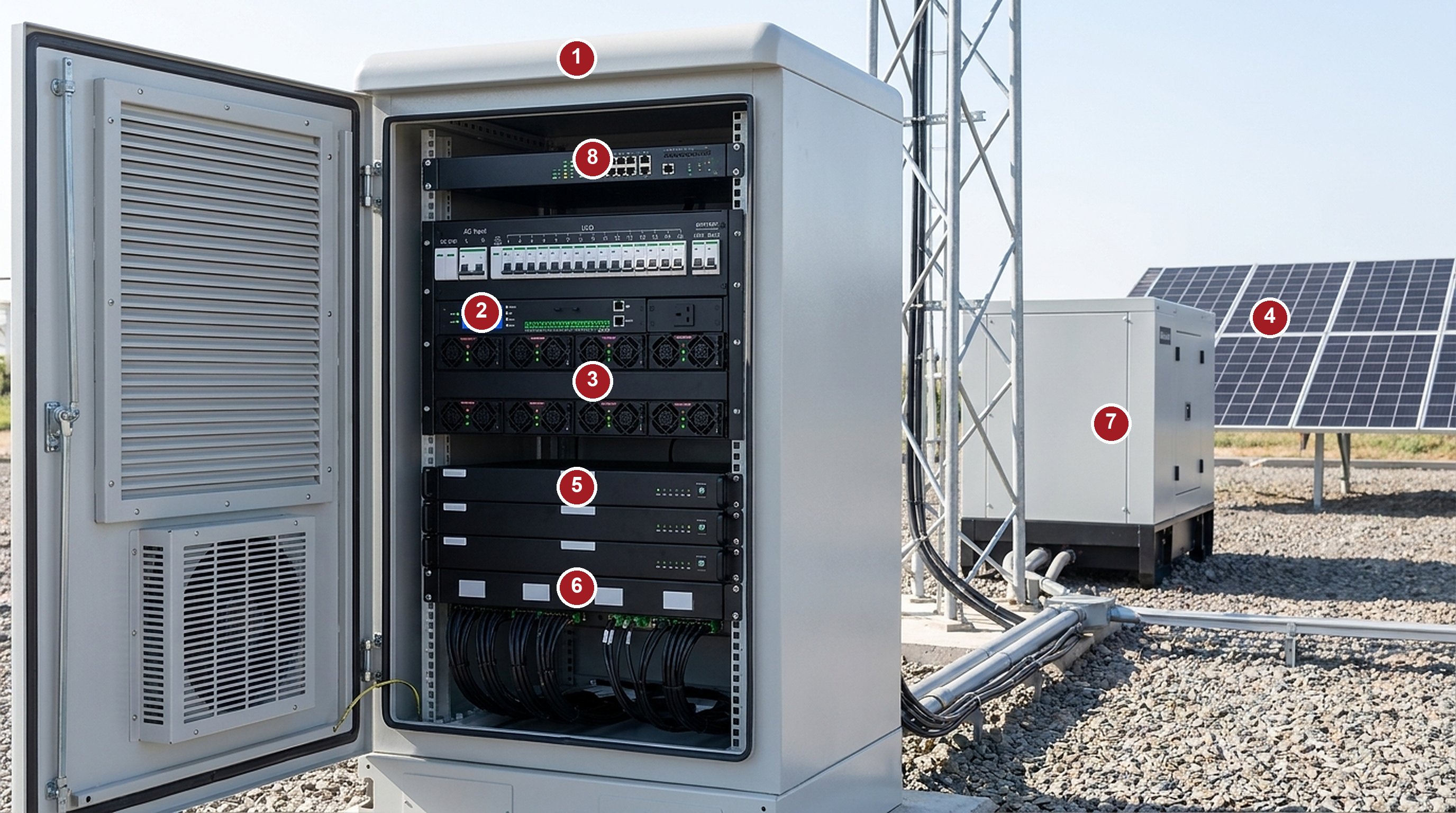
| Layer | What we deploy | Product line |
|---|---|---|
| 1. The converged cabinet | FO-ODC outdoor cabinets: insulated, galvanized shells with their own DC air conditioning, sized to hold the whole plant | Enclosures & Outdoor Cabinets |
| 2. The converged core | FO-HSDC converged cores: slot rows for rectifier and MPPT modules with a monitoring module, BLVD / LLVD distribution and surge protection, populated per site | DC Power Systems |
| 3. The rectifier shelf | FO-RM-4850 modules: 50 A / 3000 W each at 96% typical efficiency and ≥0.99 power factor at load | DC Power Systems |
| 4. The solar input | FO-PVM MPPT modules at 96% efficiency, fed by high-efficiency A-level mono modules on galvanized brackets, strings set by the site table | Solar Systems |
| 5. The lithium shelf | FO-LB51.2 series lithium in parallel expansion: over 6000 cycles at 80% DOD, with the BMS watching every single cell | Batteries |
| 6. AC out of DC | FO-INV inverter pairs in 1+1 redundancy lift 220 VAC off the bus for the site’s AC loads, capacity per site | DC Power Systems |
| 7. The genset behind | Site gensets sized from the engineering tables, filling in engineered cycles when sun and cells run out | Diesel Generators |
| 8. The nervous system | FO-FSU-1003: sensors to snapshots through 1000+ device protocols, three months of history on board, MTBF over 100,000 hours | Remote Monitoring |
Engineered per load, not per guess
The proposal behind this page sizes every site from a table: load in, module counts out.
Sized from the table
Load in, module counts out: the engineering matrix steps batteries, rectifiers, MPPTs and panel strings with the measured load, so every site gets its own configuration of the same platform.
The site nobody visits
BMS to the single cell, hardware watchdog, self-diagnosis with automatic configuration backup: the cabinet is built to meet unattended requirements.
The AC island
The 1+1 inverter pair lifts 220 VAC off the DC bus, so the site’s AC equipment rides the same converged plant as the telecom load.
The nine-hour genset day
With the battery hours and genset fill cycles coming out of the engineering tables instead of habit, the genset runs a schedule, not the clock.
One cabinet, one accountable design
The details that make the converged site an engineering document, not an assembly of hopes.
A BOM, not a shopping list
Cabinet, core, modules, battery, inverter, brackets and FSU arrive as one engineered bill of materials, sized to the site’s measured load.
Dispatch as hardware
The four source rules live in the converged core with its BLVD / LLVD distribution and surge protection, not in a script someone maintains.
Solar done properly
A-level mono modules on hot-dip galvanized brackets with PV1-F wiring and MC4 connectors, strings engineered per array: specified to the connector.
Cells with a chaperone
The BMS watches every single cell’s voltage and temperature, with overcharge and over-discharge protection layered above 6000-cycle chemistry.
Weather inside the spec
An insulated, galvanized outdoor shell with its own DC air conditioning keeps the electronics in their comfort zone whatever the site does.
A witness that outlasts the site visit
The FSU holds three months of history on board, speaks 1000+ device protocols, and runs past 100,000 hours MTBF behind a hardware watchdog.
One converged day, rule by rule
Illustrative feed. The four rules are the documented working principle of the FO-HSDC converged system; the reporting is documented FSU and S3 capability, with 24/7 support behind the platform.
Bring us your site load
Measured load, sun hours and site constraints. Our engineers return the module counts from the table, a converged cabinet specification and a quotation.