
Built for the loads that melt ordinary rooms
GPU clusters turn electricity into heat faster than air can carry it away. FIBER OCEAN engineers the AI hall as one system: dual-path Tier III power, closed containment, and a liquid heat path from cold plate to immersion, with the PUE proven live instead of promised.
Density is a system problem
Four disciplines that must hold at once when the racks run hot. We engineer all four from our own lines, sized to the cluster.
Feed it
Dual A / B paths from the MDB to every rack PDU, with hot-swap modular UPS running dual-bus in parallel.
Drain it
The liquid heat path: cold plate at 50 to 100 kW per cabinet, CDUs to 4×400 kW, immersion where density demands it.
Contain it
Closed hot-aisle containment with N+1 in-row cooling, concurrently maintainable: any unit can be serviced without dropping the room.
Prove it
An edge DCIM host streams live PUE and energy analytics, so efficiency is a dashboard number, not a brochure number.
Anatomy of a FIBER OCEAN AI build
Eight layers, one supplier, one supervision plane, shown here in the containerized format; the same stack lands as containment pods and prefab halls.
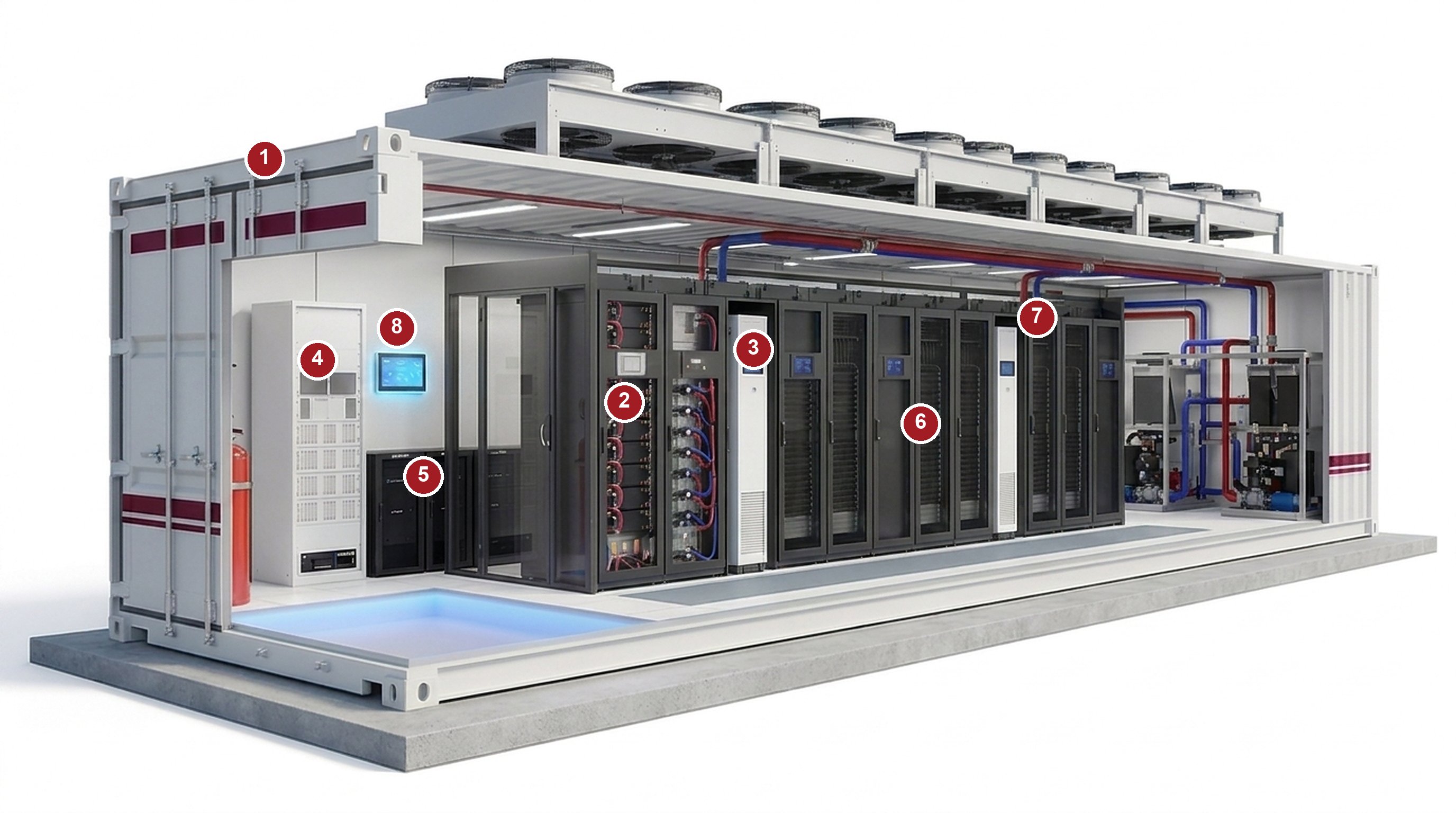
| Layer | What we deploy | Product line |
|---|---|---|
| 1. The high-density build | Containment pods in the hall you have, prefab blocks, or 20ft and 40ft AIDC container modules on the pad | AquaCore Data Centers |
| 2. The liquid heat path | Cold plate at 50 to 100 kW per cabinet with CDUs to 4×400 kW, and fluid immersion beyond it | Liquid Cooling & AIDC |
| 3. Containment & in-row | Closed hot-aisle containment with in-row units to 30 kW each in N+1, concurrently maintainable under load | In-Row Cooling |
| 4. Dual-path power | Tier III A / B paths from MDB to rack PDU, hot-swap modular UPS in dual-bus parallel operation | UPS Systems |
| 5. Battery autonomy | VRLA strings with the lithium option, sized to carry utility events and the generator transfer | Batteries |
| 6. White space | Metered or switched rack PDUs with per-outlet power, voltage, current and energy, and remote on / off | IT Racks & Smart PDU |
| 7. Connectivity | MPO/MTP trunks to 100G keep the GPU fabric patched, not re-pulled, as the cluster grows | Fiber Optics and Accessories |
| 8. The live PUE | An edge DCIM host streams PUE and energy analytics with power, cooling, environment, video and access on one plane | DCIM & Monitoring |
What the AI build is specified to do
The engineering envelope of the high-density build, as documented. Every cluster is configured inside it.
| Parameter | Value |
|---|---|
| Format | High-density AI / GPU data center (containment or prefab build) |
| Cooling approach | Closed hot-aisle containment with in-row precision and liquid cooling |
| Rack power density (kW/rack) | High-density in-row / liquid cooling, sized per GPU platform and confirmed per project |
| In-row cooling capacity | Up to 30 kW per in-row unit (rated); room-level CRAC complement for base load and redundancy |
| Cooling redundancy | N+1, concurrently maintainable; any in-row or CRAC unit can be isolated for service without dropping cooling |
| Heat rejection | Air-cooled condensers (no site water required); refrigerant R410A |
| Power architecture | Tier III dual-path (A/B) from MDB to rack PDU, with modular hot-swap UPS and dual-bus parallel operation |
| Battery autonomy | VRLA strings with lithium option; sized to ride through utility events and generator transfer |
| Rack PDU | Metered or switched; per-outlet monitoring of power, voltage, current and energy with remote on / off |
| Design PUE | ≤ 1.4 (closed-aisle containment + in-row cooling) |
| Monitoring | Edge DCIM host with live PUE & energy analytics; power, cooling, environment, video and access (Modbus RTU / RS-485 / SNMP / dry contact) |
| Environmental sensors | Temperature & humidity, photoelectric smoke and water-leak / flood detection; optional hydrogen (battery off-gas) and dust sensing |
| Fire protection | FM200 / Novec 1230 clean-agent suppression with heat & smoke detection, alarm and automatic gas activation; containment fire interlock |
| Cabinet | Server racks up to 42U; matte-black finish; IP20, anti-static, RoHS, fire-retardant |
| Reference standards | Designed to TIA-942 / Uptime Institute Tier III principles, applied per project |
| Certifications | ISO 9001:2015 (QMS); product-scoped certifications confirmed per project |
From a pod to a plant
The same eight layers, composed for how the cluster actually arrives.
The GPU pod
A contained, liquid-ready island inside the room you already run: dual-path power and in-row N+1 without rebuilding the building.
The AIDC container
20ft and 40ft factory-built modules with cold plate at 50 to 100 kW per cabinet: the training hall arrives on a truck.
The immersion room
Fluid immersion with CDUs behind it takes the estate past what air and cold plate carry, with PUE approaching 1.1.
The scale-out plan
Dual-bus UPS grows in hot-swap modules, containment adds pods, containers add halls: the fabric stays patched, not re-pulled.
Engineered for heat, audited for uptime
The details that keep a GPU estate training while its cooling is being serviced.
Liquid without site water
Air-cooled condensers reject the heat with no site water required, on R410A refrigerant: the liquid loop stays inside the system.
Serviceable under load
N+1 concurrently maintainable cooling: any in-row or CRAC unit can be isolated for service without dropping the room.
A / B all the way down
Tier III dual paths run from the MDB to the rack PDU, with the UPS growing in hot-swap modules on a dual bus.
Fire logic that knows the aisle
FM200 / Novec 1230 clean-agent suppression with heat and smoke detection and a containment fire interlock, plus optional hydrogen off-gas sensing at the batteries.
Every outlet accounted
Per-outlet power, voltage, current and energy on metered or switched PDUs, with remote on / off per feed.
PUE as a live number
The edge DCIM host streams PUE and energy analytics over Modbus, RS-485 and SNMP, next to power, cooling, video and access.
A training day, fully supervised
Illustrative feed. Every event type is documented capability of the build: N+1 concurrently maintainable cooling, per-outlet metering with remote switching, access and video on the DCIM plane, and live PUE and energy analytics, with 24/7 support behind it.
Bring us your cluster profile
GPUs per rack, kW per cabinet, growth curve and where it all has to stand. Our engineers return a heat-path design, a dual-path power plan, a supervision plan and a quotation.