
Solar leads, diesel fills the gaps
Every liter of diesel a remote site burns is a logistics chain. FIBER OCEAN blends solar, battery, generator and whatever grid exists onto one DC bus, engineered so the sun does the day shift, the battery does the transitions, and the genset runs only when it must.
One bus, four sources
A hybrid site is an energy dispatch problem solved in hardware. We engineer the four sources onto one bus, from our own lines, sized per site.
Solar leads
The array takes the day shift through solar-compatible charging at a flexible 10–50 A, built into the plant, not bolted on.
The battery floats
LiFePO4 floats on the bus, buffers the load and takes over with zero transfer time when the grid drops.
Diesel fills
The genset becomes the backup’s backup: fewer run-hours, fewer fuel convoys, lower OPEX at every remote site.
The bus decides
Rectifiers at ≥96% efficiency and the site controller arbitrate sources on one −48 V bus, reporting every decision upstream.
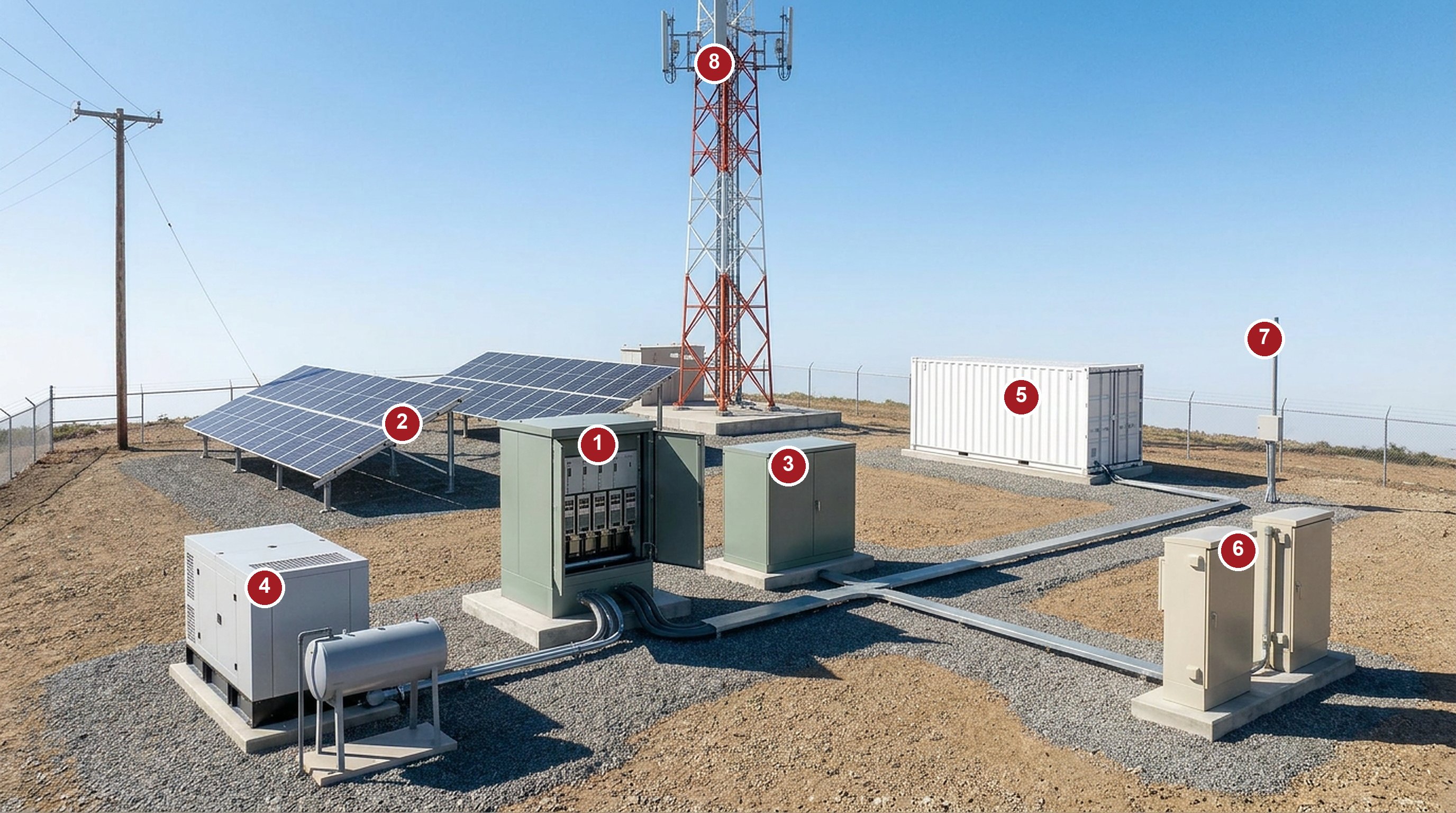
Anatomy of a FIBER OCEAN hybrid site
Eight layers on one bus. Every numbered element is a FIBER OCEAN line, engineered together so the dispatch order is physics, not luck.
| Layer | What we deploy | Product line |
|---|---|---|
| 1. The hybrid bus | The hybrid DC cabinet blends rectifier power from grid or genset with solar on one −48 V bus, up to 400 A | DC Power Systems |
| 2. Solar input | Solar-compatible charging at a flexible 10–50 A lets the array lead the day wherever the sun allows | Solar Systems |
| 3. The floating battery | Outdoor LiFePO4 string, 48 V / 50 Ah with 2000 cycles at 80% DOD and zero-transfer takeover on grid loss | Batteries |
| 4. The diesel fill | Gensets from 10 kVA canopies, on trailers or in containers, down to 55 dB at 7 m, running only when needed | Diesel Generators |
| 5. Site-scale storage | EnergyGuard BESS from 50 kW cabinets to a 1 MWh container where the site is bigger than a tower | EnergyGuard Storage |
| 6. Hardened housing | FO-NPC and sibling IP65 outdoor cabinets built for power and solar equipment, rated for −40 to +65 °C | Enclosures & Outdoor Cabinets |
| 7. Site telemetry | The FSU watches fuel level, mains, gate and camera at every site and raises tickets through TT integration | Remote Monitoring |
| 8. The fleet view | S3 reports energy by day, month and year with year-on-year ratios across the whole fleet, supported 24/7 | Remote Monitoring |
Four grids, one discipline
The same bus, weighted for the grid each site actually has.
The off-grid tower
Solar leads, the battery carries the transitions, diesel fills the gaps: the site stays on air with the fewest run-hours the sun allows.
The poor-grid site
Unstable mains become just another source: the battery takes over with zero transfer time and the bus rides through every brownout.
The retrofit
An existing genset site gains solar and a floating battery: the genset drops from prime mover to filler, and the fuel bill follows.
The hybrid rollout
One engineered site design replicated across the estate, with every site’s fuel, energy and alarms reporting to one center.
Run-hours are the metric
The details that turn an energy mix into an OPEX line you can defend.
One bus, not four vendors
Grid, genset, solar and battery meet in one hybrid DC cabinet with MPPT solar charging, engineered as a system instead of negotiated at the terminal block.
Solar built into the plant
10–50 A solar-compatible charging is native to the hybrid range, so the array is a source, not an accessory.
A battery that never blinks
The outdoor lithium string floats on the bus and takes over with zero transfer time on grid loss, 2000 cycles at 80% DOD deep.
Hot-swap to the module
RM4850 / RM4875 rectifiers and the MCU-SM32Z controller are interchangeable with the indoor range; fanless DC Lite modules cover pole and rooftop sites.
Housed for the desert
IP65 outdoor cabinets built for power and solar equipment, rated for −40 to +65 °C service, covering hot outdoor areas of 55 °C and above, plinths included.
Fuel is telemetry
Tank level, mains state and genset runs stream from every site; year-on-year energy ratios make the diesel savings auditable.
One day on the hybrid fleet
Illustrative feed. Every event type is documented S3 / FSU or hybrid-range capability: generator and main power alarms, fuel level monitoring, zero-transfer battery takeover, TT integration, and day, month and year energy reporting with year-on-year ratios, supported 24/7.
Bring us your site profile
Load, sun hours, grid quality and fuel logistics. Our engineers return a dispatch design, a sized hybrid plant, a fleet supervision plan and a quotation.